
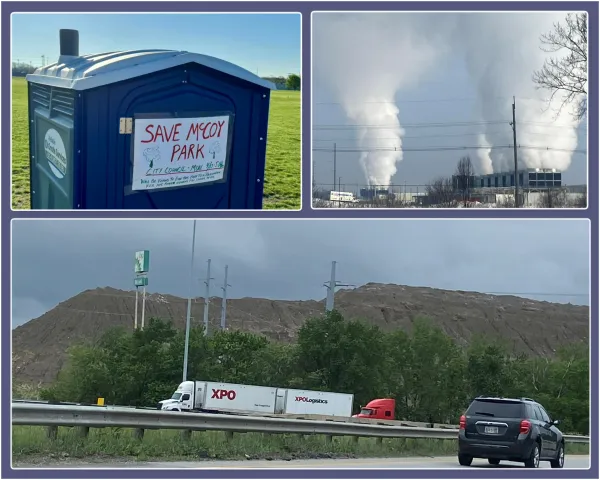
A gigantic mountain of dirt and rocks on the South Side looms over the 270 outer belt and it’s becoming more gigantic by the day.
Directly across from this mountain is a monster-sized data center that came online in 2025.
And like McCoy Park – a local park ditched to become a professional sports complex – all three are symbols of how Columbus City Hall historically treats most of the South Side of Columbus – like dirt.
“The people of the South Side and Far South Side are frustrated,” says South Side activist Bruce Miller, who City Hall took revenge on for simply advocating for longtime residents. “They have no one in media listening. City Hall calls them literally a bunch of dumb pig farmers who don’t deserve good things. And their legitimate concerns are dismissed. And they wonder why the community in the last several elections has voted red.”
McCoy Park, after years of taxpayer funded investment and planning, was set to be transformed into a modern-day egalitarian marvel. The park, located in the proximity of where the South Side begins, was going to be “adaptive” or designed for those with disabilities.
Denying wheelchair bound kids the chance to experience a splash pad like physically healthy kids is the “Columbus Way.” A decision the ultra-rich make when they know they can get away with because the so-called “pig farmers” don’t have the influence or finances to push back.
Miller, a nurse who no longer lives in Columbus, tried to give South Siders a voice at City Hall for over a decade. But City officials devised ways to silence him like they do to many activists. He once led the Far South Columbus Area Commission – but was forced out by City officials for speaking against Zone In.
The City continued to retaliate and it became far more personal. Miller was participating in a homebuyer program offering reduced mortgage rates if you rehab an eyesore, but the City ended his involvement which skyrocketed his mortgage payment.
“We had to sell our house and move. We left the state because of these and other threats made by City leadership,” he said.
As for that mystery mountain of dirt off Route 23 and south of 270, it is another mess propagated by the (un)legendary Ohio-based Shelly Mining Company. With City approval, Shelly over many decades has dug out numerous quarries throughout Columbus extracting limestone to make asphalt. After the limestone is removed, environmental consequences are left in the aftermath.
“We had Shelly expansion all the way down South High to the county line to blast everything between South High and the river [Scioto] for a quarry and then flood the quarry with river water and abandon it,” said Miller.
Across Rt. 23 from the quarry is the new Google data center. Above is a recent picture taken by the Free Press of this data center’s emissions, and the debate of what exactly is in those clouds rages on.
“For that whole area we had hundreds of residents with environmental concerns,” Miller says, “from the pollution of the existing city water wells on Parsons Avenue, to Google causing brownout and using too much water, to the air quality, to the earth tremors from Shelly blasting up to the backyards of existing homes and then flooding the huge pits with dirty water.”
He continues, “We were told it wasn’t our concern by the Department of Neighborhood’s high-ranking staff.”
To City officials’ credit, a new metro park was developed behind the Great Southern Shopping Center. However, environmental issues have emerged here too.
“Behind the Great Southern Shopping Center there are massive sinkholes that have formed and have taken down AEP transmission lines, swallowed parking areas, and destroyed some of the metro park lands. I believe the fire department had to pull unsheltered individuals out of one,” said Miller.
Even if he no longer lives here, Miller continues to advocate for the South Side.
“Hundreds of South Side and Far South Side voices were flat out ignored because the City had predetermined they wanted these projects and that City Hall knew what’s best even if it sacrificed the local resident’s health, housing, jobs, water food and safety.”